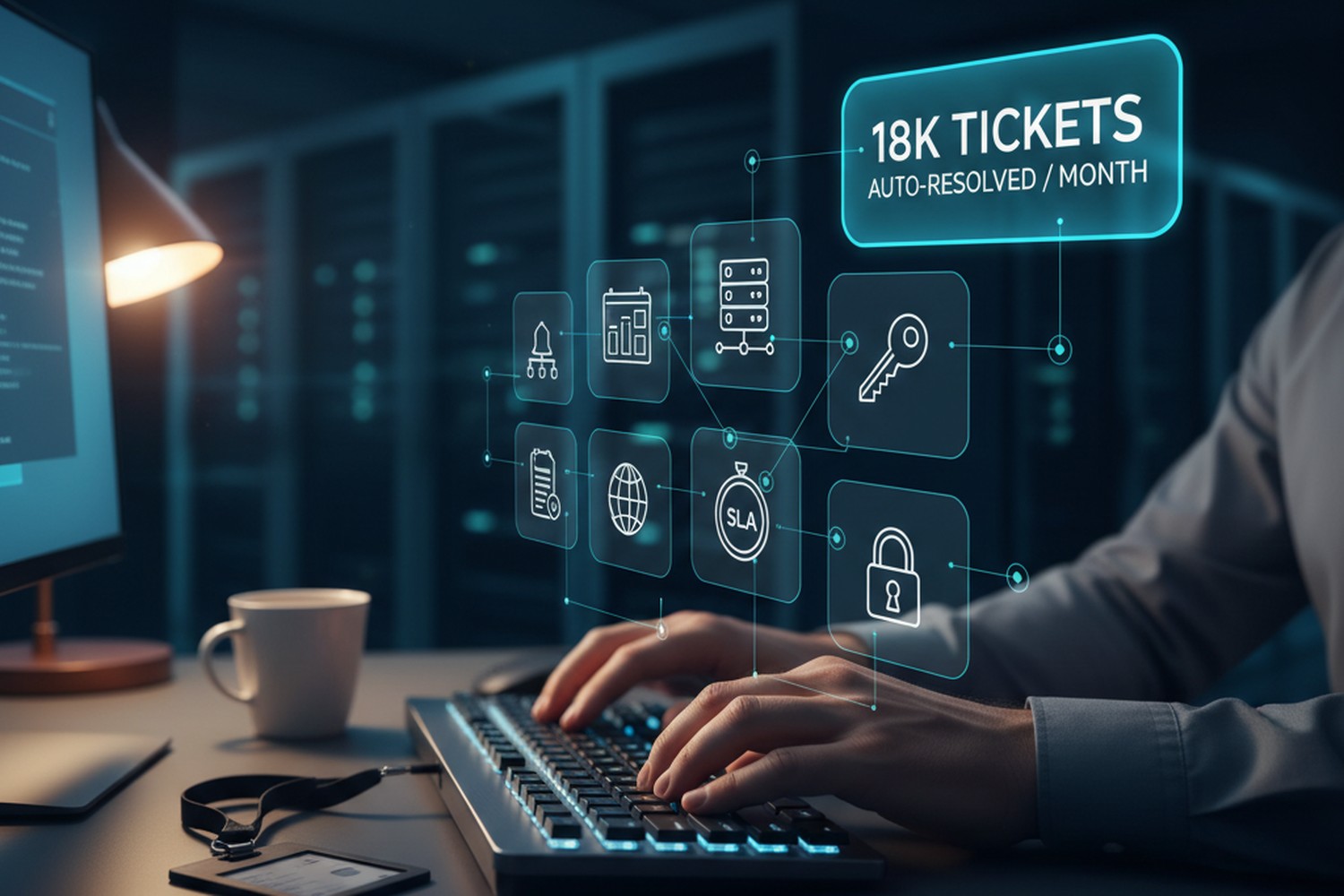
How a Global Retail Bank Took 18,000 L1 Tickets Off Its Service Desk Every Month — and Saved $1.8M in Year One
Case Study

How a Global Retail Bank Took 18,000 L1 Tickets Off Its Service Desk Every Month — and Saved $1.8M in Year One

Their 85,000 employees across 14 countries were generating 26,000 IT service tickets a month — 68% of them the same password, VPN, MFA and Microsoft 365 questions on repeat. We built a hierarchical multi-agent platform on LangGraph + OpenAI GPT-4o + Microsoft AutoGen, embedded inside ServiceNow ITSM — and unlocked 18,000 L1 tickets auto-resolved every month, mean-time-to-first-response from 47 minutes to under 60 seconds, and $1.8M in annualised savings inside 12 months. Faster resolutions. Happier employees. SOX and BSA/AML audit trail intact.

Discuss Your Project


How a Global Retail Bank Took 18,000 L1 Tickets Off Its Service Desk Every Month — and Saved $1.8M in Year One
Trusted By Startups, SMBs to Fortune 500 Brands

Quick Answers

Skim the case in 60 seconds — what was breaking, what we built, what changed in year one.

Overview

Meet the bank. An 85,000-employee global retail bank operating across 14 countries, processing 26,000 IT service tickets a month through a service desk that was bleeding morale and budget.

Challenges

Five forces were grinding the L1 desk down at the same time — repetitive ticket volume, cost-per-contact, response-time SLAs, console sprawl, and an audit chain that couldn't slip a single change.

How the AI IT Service Desk Agent Platform Works

Five steps, end to end — from the moment an employee submits a ticket to the moment the resolution is logged and the audit trail is closed. Most of those steps, the agent crew now runs entirely on its own.

Solutions Delivered

Four architectural pillars carry the load. Each was chosen for a specific reason; together they're what turned a 47-minute first-response into a 60-second one.

Instead of a single monolithic ITSM chatbot, the system runs as a hierarchy of agents — a top-level triage agent that classifies intent and risk, and a fan-out of specialist agents (password, access, network, application, escalation) each with its own narrow toolset. LangGraph routes between them, holds state across multi-turn conversations, and decides when a human reviewer needs to step in. The architecture is the difference between a system that answers 50% of L1 and one that closes 73%.

GPT-4o handles the triage layer — fast classification of intent, risk and the right specialist agent to invoke. Anthropic Claude 3.5 Sonnet does the actual conversational reasoning across multi-turn tickets where context spans Okta logs, AD lookups and earlier IT history. The two-model split was a cost-and-quality call: GPT-4o is cheaper and faster for triage at 26,000 tickets a month; Claude is stronger on long-context reasoning where it matters.

The specialist layer is built on Microsoft AutoGen — one agent per L1 category, each with its own scoped tools. The password agent has Okta API access; the access agent has Active Directory and Citrix; the network agent has VPN-concentrator and firewall hooks; the M365 agent has Microsoft 365 admin. No specialist can step outside its toolset — a hard security boundary the bank’s risk team signed off on.

The agent crew lives inside the ServiceNow ITSM workflow L1 agents already use. Tickets are picked up, worked, and closed inside ServiceNow with a complete audit trail — no parallel-universe console. SOX-controlled changes (any privileged access, anything affecting banker accounts, anything BSA/AML-relevant) always route to a human L2 reviewer with the full agent transcript, tool-call log and recommended action attached. Every reviewer override feeds the retraining pipeline.

Success Metrics

Year-one results, measured the way a bank CIO measures them — automation rate, MTTR, cost-per-contact, employee satisfaction. No vanity metrics.

18,000

L1 tickets auto-resolved every month across all 14 country operations

73%

Straight-through resolution rate — three in four L1 tickets close without a human

$1.8M

Annualised savings unlocked in the first 12 months of production

47 → 60s

Mean-time-to-first-response collapsed from 47 minutes to under a minute

26K

Monthly IT tickets now flowing through the agent crew

Zero

SOX, BSA/AML and audit findings in year one

The New Normal for the Service Desk

What started as a queue overflow became an operating-model shift. Today, nearly three in every four L1 tickets close themselves — accurately, auditably, in seconds instead of minutes — while the bank's L2 and L3 engineers focus on the complex, high-risk cases that genuinely need an expert. MTTR is down from 47 minutes to under a minute. The L1 cost line is down $1.8M a year. And the crew gets smarter every week, learning from every human override fed back into the LangGraph + GPT-4o + AutoGen stack. The bigger story: AI didn't replace the service desk — it gave the bank's IT team back the time to actually fix things. That's the difference between a chatbot and an AI service-desk agent.

Trusted by Industry Leaders Worldwide

Powering Growth Through Technology

From AI driven platforms to enterprise software and custom applications, businesses across industries rely on DreamzTech to accelerate innovation, improve operations, and drive measurable growth. Let’s discuss how we can help your business next.

Book a Discovery Call

    I Consent to Receive SMS Notifications, Alerts from DreamzTech US INC. Message frequency may vary. Message & data rates may apply. Text HELP for assistance. You may reply STOP to unsubscribe at any time.
    I Consent to Receive the Occasional Marketing Messages from DreamzTech US INC. You can Reply STOP to unsubscribe at any time.
    By submitting the form, you agree to the DreamzTech Terms and Policies
    NEXT STEPS

    Explore Our Solutions

    Six purpose-built AI agent platforms — one for every operations team. Pick a use case, see exactly what we ship.

    Proven Impact

    More AI Success Stories

    Explore how DreamzTech helps businesses automate document heavy workflows across legal and insurance sectors with faster processing, improved accuracy, and measurable ROI.

    Our AI Capabilities

    Industry Focused AI Development Services

    Explore our comprehensive AI solutions tailored for different industries, including AI agents, multi agent systems, automation platforms, consulting, and enterprise AI integrations.

    Frequently Asked Questions (FAQ)

    The questions bank CIOs, ITSM leads and risk officers ask us most when scoping an ITSD-automation build like this one.

    L1 routine categories — password resets, MFA enrolment, VPN access, Microsoft 365 licensing and group membership, software installation, common application errors, and standard access-request workflows. Anything novel, anything BSA/AML-flagged, anything touching privileged accounts always routes to a human.

    The ticket is handed off to an L2 engineer inside ServiceNow with the full agent transcript, every tool call the agent made, the recommended next action, and a confidence breakdown attached. The engineer either approves the recommendation, edits it, or takes over completely — every override is captured for the next retraining cycle.

    Yes. Every agent action — every Okta call, every AD lookup, every ticket update — writes an immutable audit entry. SOX-controlled changes always route to a human reviewer. BSA/AML-relevant requests (banker-account access, sanctions-screened actions) are flagged in triage and never auto-execute. SOC 2 Type II controls in place across the full pipeline.

    Ten weeks to a single-region production pilot. Eighteen weeks for the full 14-country rollout the bank ran. The bank in this case went from kickoff to year-one outcomes — 18,000 L1 auto-resolutions a month, $1.8M savings, MTTR from 47 minutes to under 60 seconds — inside 12 months.

    Yes. Native integration with ServiceNow ITSM (the bank’s primary platform), plus Jira Service Management and BMC Helix where required. We also integrate with the standard L1 tool surface — Okta, Active Directory, Microsoft 365 admin, Citrix, Cisco/Palo Alto VPN, SailPoint IGA — so the agent crew can act, not just chat.

    Every L2 override is captured, labelled and fed into a weekly retraining job. Containment, MTTR and re-open rates are tracked per ticket category in dashboards so confidence thresholds can be tuned where the agents are over- or under-resolving. Most engagements see auto-resolution climb another 5–10 percentage points in the first six months after launch.